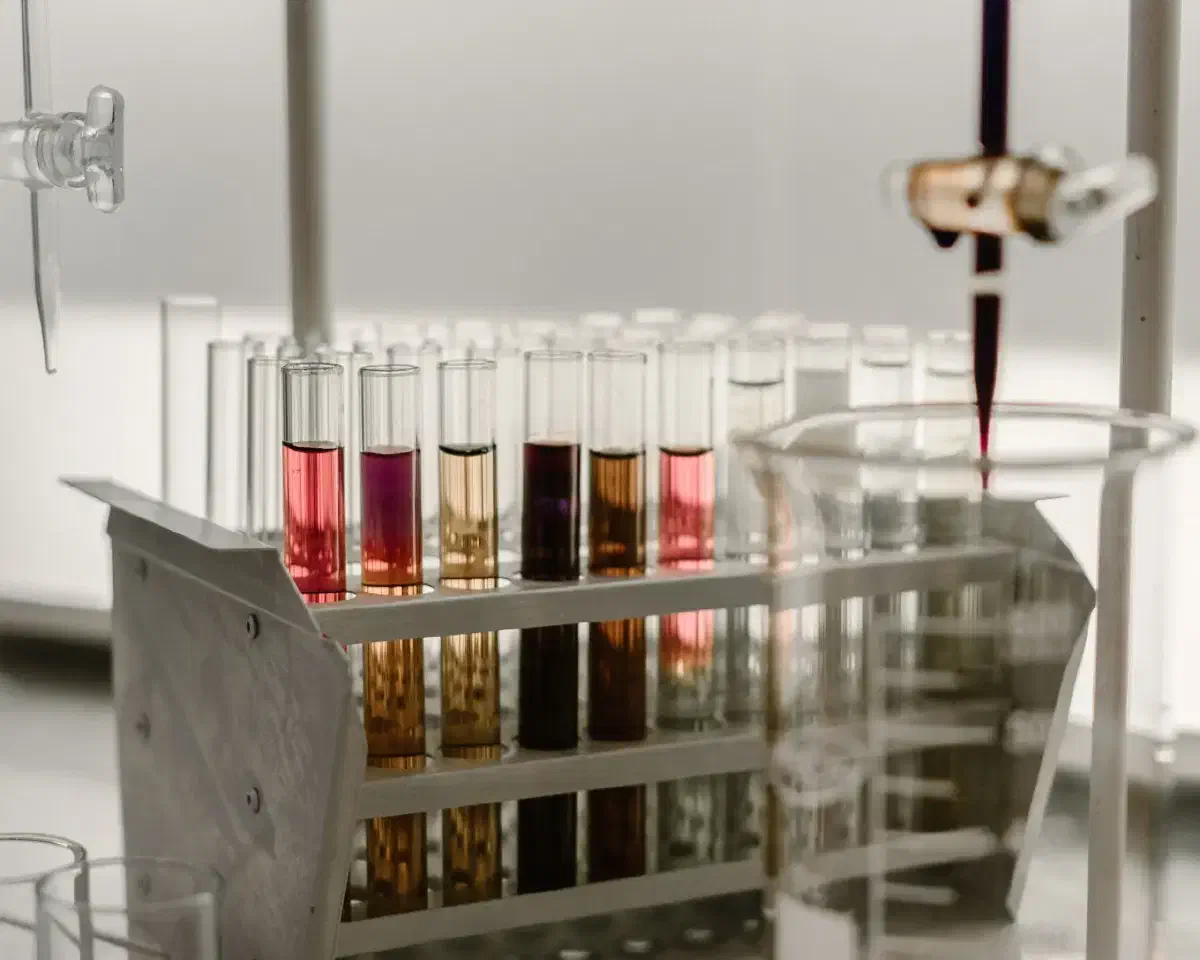
I’m made of stuff that’s constantly interacting with other stuff, right? And I feel like at this point in my life I’ve put myself in a tight tube filled with tiny things that are blocking my path, so the only way to go through is to build up pressure and go for it. Then depending on how I interact with the stuff that’s inside this tube, I’ll take longer or shorter to get to the other side.
I’ve just described liquid chromatography but that’s not important—I’m determined to silence the inner critic that’s whispering to my ear, “nobody cares about your bachelor’s”. Well you’re still reading, so you’re now in possession of chemistry knowledge you didn’t ask for nor will ever need. I’m so evil.
The point was that chromatography was pretty much a good analogy of what I need to do to progress in life, so it seems. In many ways this section of 2026 is an experiment I’m running on myself, and also like a regular laboratory, it’s not limited to this one run. I’m going to run through many more tight tubes in the future and experiment with different conditions until I find the optimal settings.
It’s interesting how that works, because in real life research would go something like this; you identify something you don’t know, then form a hypothesis based off what you do know, make a couple predictions of what would happen if that were true, then finally carry experiments and this confirms or rejects your idea. But if I’m the sample then the cycle reverses; I identify something I’m missing, but then go straight to the experiment to gather data and only then do I formulate conclusions. I guess the objective is not to confirm a truth and publish it, but to create truth, therefore the process is iterative and never ending.
But what can I provide aside from a shitty comparison between concepts? It would be great if we could make a parallel between the two to apply what we know of the scientific method to our personal, iterative self-improvement.
Lesson number one would be to have a definitive goal, a timeline, and naturally also a budget. Research works by formulating an idea and presenting it to a committee that grants you funds for this, and in your own personal life, you’d be the judge that grants time to that idea. It’s also cool to have some kind of deadline, even a soft one like “few months in the future”, so you don’t slack off indefinitely.
Lesson two would be to draw from past experiences. Scientists have access to a huge collection of experiments from previous research, and this allows to know in advance what might fail or succeed and why. They’ll also often copy study methods from other authors. In real life you’d learn not just from other people how to convert a habit into reality, but from yourself. I remember trying to use movies as a prize in the past to reward myself for good work, and it working beautifully, so there I’d have one tiny piece of the puzzle already placed (or solved?).
Lesson three, be thorough and open. Research doesn’t always result in a confirmation of a hypothesis—on the contrary, many papers are published with a negative answer, which is valuable because it serves the same purpose. “What didn’t work here?” is just as valid of a question as “what worked?”. So when I’m trying to form a habit these days, I note how I’m feeling at the end of the week, and change course if there’s a dip in productivity or I’ve fallen into old patterns.
I was looking at the previous paragraphs and my inner critic was telling me that it would be cool to have more than just three lessons, and what do these have to do with the way that I started the first paragraph? But you see, for my writing habit I’ve chosen not to edit at all, so jokes on you, critic, because this is getting published as-is. Cheers, and have a good day.
No comments yet.